In 1921 and 1925 Postmodernism Was a Way People Called the New Art and Music
Music has come up along mode in the terminal yard years or so, and we're going to tell yous how! From Gregorian Chants to Mozart's sonatas, we're going to give you a brief history of the 6 Musical Periods and how they've each contributed to music today.
The vi musical periods are classified as Medieval, Renaissance, Bizarre, Classical, Romantic, and 20th/21st Century, with each fitting into an approximate time frame.

Medieval (1150 – 1400)
Though we can assume that music began far before 1150, the Medieval period is the first in which we can be sure every bit to how music sounded during this time. Well-nigh notated manuscripts from the Medieval catamenia came from the church building or places continued to the church, and so most pieces take a religious subject.
Instruments used during this time included the flute, the recorder, and plucked cord instruments, like the lute. Early versions of the organ and fiddle besides existed.
Perhaps the nearly known type of music to come out of the Medieval menses was the Gregorian Chant. Gregorian Chants were monophonic, (a single, unaccompanied melodic line) and most commonly sung by monks. Take a moment to listen to the Gregorian Chant below. Notice the annotation in the background too, which has also drastically inverse over fourth dimension.
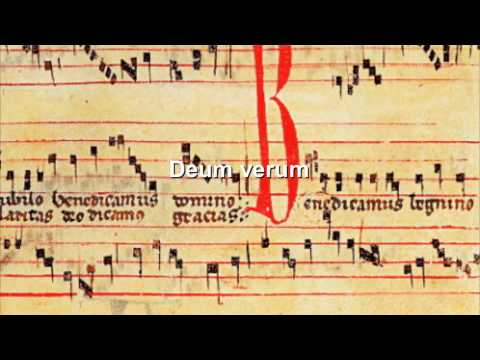
Though the monophonic style was a staple in the Medieval period, it'southward important to note that polyphonic vocal genres also developed in this time. Polyphony is the apply ofmultipleindependent voice types, as opposed to theone melody line in monophonic singing.
It can be concluded that the introduction ofharmony began in the Medieval menstruation.
Though a big portion of the music written in this era is non attributed to whatever author, John Dunstable, Adam de la Halle, Phillippe de Vitry, Guillaume de Machaut, and Francesco Landini were all notable composers in this period.
Renaissance (1400 – 1600)
The Renaissance brought significantly increased amounts of harmony and polyphony into music, every bit near composers were focused on choral music.
The Renaissance was a golden age for choral composition, particularly in a capella compositions.
Religious music continued to flourish throughout the entire Renaissance period, including new forms such as masses, anthems, psalms, and motets. Some composers of sacred music began to adopt secular forms (such as the madrigal) towards the end of the menses. Accept a moment to heed to "The Silver Swan," a famous choral piece still sung today by composer Orlando Gibbons.
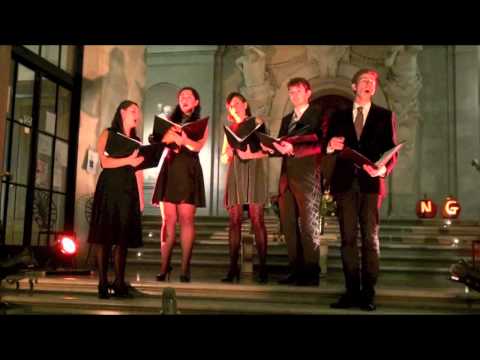
Instrumentation became more prominent during this menstruum, with the introduction of:
- Early on brass instruments: slide trumpet, cornet, valveless trumpet, sackbut
- Adapted string instruments: viol, rebec, lyre, lute, guitar
- The harpsichord
- Pocket-sized percussion instruments: triangle, tambourine, bells, small drums
- Early woodwind instruments: reed pipe, bagpipe, transverse flute, recorder
The 2nd one-half of the Renaissance menstruum was incredibly influential, as composers became to motion away from the modal system of harmony and towards the organisation of major and small-scale scales.
The stiff sensation of each piece having a definitely tonalcentre (or fundamental) became commonplace in the Renaissance flow.
Notable composers of the Renaissance include William Byrd, John Dowland, Orlando Gibbons, Giovanni Pierluigi da Palestrina, and Thomas Tallis.
Baroque (1600 – 1750)
Expanding upon the end of the Renaissance menstruum, the Baroque menstruum saw the creation of writing music in a particularkey. Withal, the Baroque menstruation is commonly known for circuitous pieces and intricate harmonies. Even so, this period laid the groundwork for the next 300 years of music.
The idea of the modern orchestra was built-in, forth with opera, the concerto, sonata, and cantata. Choral music was no longer king, as composers turned to compose instrumental works for diverse ensembles. "Classical" music gradually began to piece of work its mode into gild, being played outdoors at dinner parties and special functions, or equally a spectacle in the form of opera.
George Frederick Handel'sWater Music is an splendid example of a typical Baroque catamenia piece, composed for Rex George and performed on the River Thames.
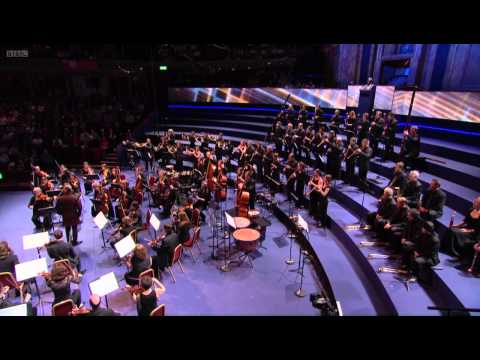
As instrumental pieces became more prominent, individual instruments advanced drastically. Many new instruments emerged, such as the oboe, bassoon, cello, contrabass, and fortepiano (an early on version of the pianoforte). The cord family unit of the Renaissance was replaced with stronger sounds from the violin, viola, and cello. The invention of the harpsichord flourished, and all existing woodwind and brass instruments were updated and advanced. The Bizarre period also introduced stronger percussion with instruments like the timpani, snare drum, tambourine, and castanets.
Early Baroque composers included Claudio Monteverdi, Alessandro Scarlatti, Henry Purcell, and Jean Baptiste Lully, while after Baroque composers included Johann Sebastian Bach, George Frederick Handel, Georg Philipp Telemann, Jean-Philippe Rameau, Dominico Scarlatti, and Antonio Vivaldi. These later composers contributed substantially in the transition to Classical music.
Classical (1750 – 1820)
The term "Classical Music" has two meanings
- The broader meaning includes all Western art music from the Medieval era to the 2000s.
- The specific meaning refers to the music from the 1750s to the early 1820s.
Nosotros are discussing thespecific significant in this section.
The Classical period expanded upon the Baroque menstruation, adding a majorly influential new vocal form: the sonata. This period also saw the development of the concerto, symphony, sonata, trio, and quartet.
The Classical period is most known for information technology's coercion for structural clarity in music.
Though this period didn't add any majorly new instrumentation, the harpsichord was officially replaced with thepiano(or fortepiano). Orchestras increased in size, range, and ability, and instrumentation overall had a lighter, more evident texture than Baroque music, making it less complicated.
Notable composers from the Classical period include musical giants Joseph Haydn, Ludwig van Beethoven, Franz Schubert, and of course, Wolfgang Amadeus Mozart.
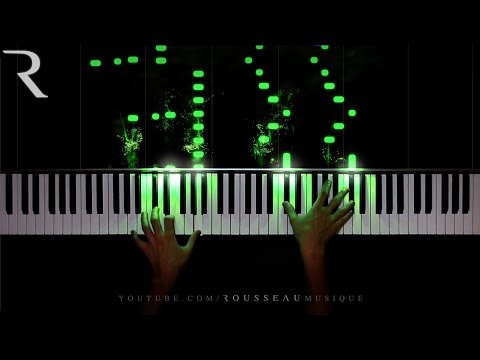
Listen to ane of Mozart'southward most famous pieces, "Rondo Alla Turca" from hisPiano Sonata No. 11 performed by Musicnotes Signature Artist, Rousseau.
Romantic (1820 – 1900)
Beethoven and Schubert bridged the gap between the Classical and Romantic periods of music. Just as one might assume from the discussion "romantic," this period took Classical music and added overwhelming amounts of intensity and expression. Every bit the period developed, composers gradually let go of heavily structured pieces and gravitated towards drama and emotion.
The Romantic era was the golden age of the virtuoso, where the most difficult music would be performed with nonchalant ease.
Instrumentation became even more prominent, with orchestras growing to higher numbers than ever earlier. Composers experimented in new ways, trying out unique instrumentation combinations and reaching new horizons in harmony. Public concerts and operas moved away from the exclusivity of royalty and riches and into the hands of the urban middle-class order for all to enjoy.
The Romantic period was also the beginning period where national music schools began to appear. This era produced some of music'due south most adored composers, including Hector Berlioz, Frederic Chopin, Felix Mendelssohn, Robert Schumann, Franz Liszt, Johannes Brahms, Peter Ilyich Tchaikovsky, and Richard Wagner. The very end of the Romantic period likewise brought about composers Gustav Mahler, Richard Strauss, Giacomo Puccini, Jean Sibelius, Camille Saint-Saëns, Gabriel Fauré, and Sergei Rachmaninoff.
Take a moment to heed to Chopin's "Nocturne in E-flat Major (Opus 9 No. 2)" and compare information technology to Mozart's"Rondo Alla Turca."
20th Century and 21st Century (1900 – Current)
20th Century and 21st Century tin be cleaved down into even smaller periods.
- Impressionist: 1890 – 1925
- Expressionist: 1908 – 1950
- Modern: 1890 – 1975
- Postmodern: 1930 – present
- Gimmicky: 1945 – present
Nonetheless, these sub-genres are normally lumped into one large category since there are and so many diverse and opposing styles.
The 20th and 21st centuries can only exist described equally free reign for composers.
Each flow we've described up until the 20th and 21st centuries had a general set of guidelines and characteristics that nearly composers followed. Over time, composers accept been pulling further and further abroad from rules and restrictions into what is ultimately now a identify of complete free reign. Classical music is now a place for the ultimate experimentation, and though it may not be every bit popular in 2022 as information technology was in 1800, it certainly has not disappeared.
Prolific composers in this period include Igor Stravinsky, Béla Bartók, Dmitri Shostakovich, Claude Debussy, Maurice Ravel, Gustav Holst, Arnold Schoenberg, andmany more than.
Possibly 1 of the about famous classical pieces of musicever was composed during this time: "Clair de Lune" by Claude Debussy.
Classical music has come along way, and endless composers have contributed to making it what it is today. Perhaps what we've learned more than anything is that classical music is one matter: timeless. We still look dorsum to the kickoff from time to time and remember the beautiful music so many people fabricated. We're thankful for their difficult work, for the wonder they gave us, and the gift of classical music that always keeps giving!
Disclosure of Material Connection: Some of the links in the postal service above may be "chapter links." This ways if you click on the link and brand a purchase, Musicnotes will receive an chapter committee. We are disclosing this in accord with the Federal Trade Commissions 16 CFR, Part 255: "Guides Concerning the Use of Endorsements and Testimonials in Advertizing."
Source: https://www.musicnotes.com/now/news/musical-periods-the-history-of-classical-music/
0 Response to "In 1921 and 1925 Postmodernism Was a Way People Called the New Art and Music"
Post a Comment